


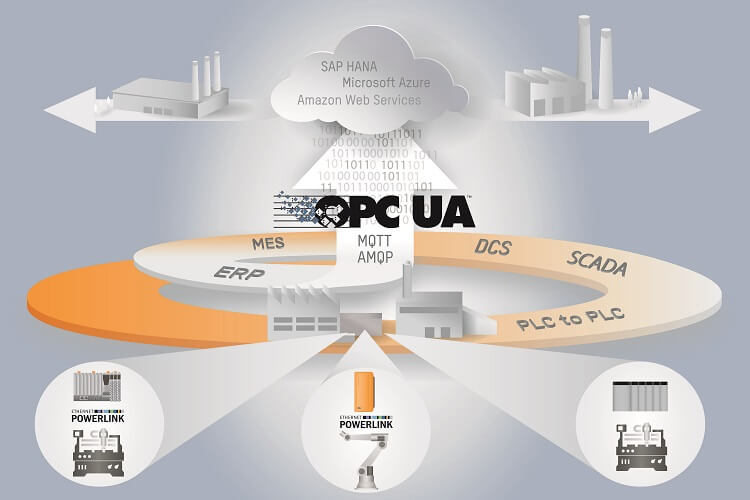
OPC (OLE for Process Control), released in 1995,is a standard that provides industrial communication. OPC allows machines and systems from different manufacturers to transfer data using the same interface. OPC aimed to communicate HMI / SCADA systems with machines without special drivers and driver software.
Today, this system, called Classic OPC, is still widely used. The OPC had issues such as compatibility issues, security issues, dependence on Microsoft platforms, expensive and inactive data migration methods, and maintenance difficulties. All these troubles led to the emergence of OPC-UA as an heir to the OPC.
OPC-UA (OPC Unified Architecture) is the next generation of OPC technology. It provides more secure and almost complete data transfer between servers and clients.
OPC-Unified Architecture has a dual structure with object-oriented and service-oriented features. The object-oriented feature provides a common object management method to support asset reusability and complex data models. OPC-UA’s service-oriented structure, on the other hand, provides greater interoperability with other platforms.
OPC is the first communication technology that can travel between firewalls, private platforms and security barriers in the transmission of data.
OPC-UA; It generates and controls real world data with databases, analytical tools, ERP systems and other business systems and relates it to real world data.
OPC-UA uses scalable platforms, multiple security models, multiple transport layers and a complex information model to allow the smallest custom controller to freely interact with complex, latest server applications.
Features of this technology include;
* OPC-UA is platform independent and scalable. It is compatible with the latest servers and old version sensors.
* OPC-UA has flexible address space. It creates an address space appropriate to the object concept. It provides a standard way for servers to transfer information to clients.
* OPC-UA guarantees the security of clients and servers with authentication and encryption.
* The internet capacity is quite large.
* OPC – UA provides layout, alarm, read, write, discover features.
* Provides certified interoperability. It confirms the profiles that can be guaranteed using a defined profile.
* It has an Advanced Information Model.
* The OPC Association works with industry trade groups to identify and support specific information models
IoT (Internet of Things) is similar to multiple technologies such as radio frequency identification (RFID), Internet, Wireless, sensor technology, cloud. All these technologies contribute to IoT infrastructure. In fact, IoT, which is there to improve its computer capabilities, is seen as a communication infrastructure all over the world today. It has been defined as the technology of the future not only for human to human, machine to human but also for machines to communicate.
OPC-UA has been developed as an interface software solution for resource limited devices. In this way, a huge amount of IOT data has become workable. IoT data can be stored in a cloud database.
OLE is a program integration technology that we can use to exchange information between programs. We can copy information as a linked object from any program that supports Ole
OPC – UA technology and architecture consists of three main modules. Connect Server, Collector Server, Cloud Proxy Server. Connect Server can be in the form of three different servers. Facility network connection, control network connection, area network connection. All of these layers are used to model all data, from factory machines to corporate devices. In the collection part, data is collected in a field. The client can thus reach multiple servers. Limitations are provided for data security on the merge server, and encryptions are used. The Cloud Proxy server provides a proxy connection. Different industrial data with different applications can exchange information through layersthus a dynamic automation system can be created.
OPC-UA has all the standards of existing OPC servers and has been developed on top of them. There have been some problems with standards of this magnitude. The most basic of these is the applicability of OPC-UA. In order to ensure easy applicability, new standards were created and a Software Development Kit, the SDK, was developed.
The SDK consists of a programming interface and sample code applications. It offers different options to facilitate its usage and adoption on different platforms. It offers NET, ANSI C and Java sample applications.
Each option in the SDK is designed to meet memory, processor requirements and specific needs, and they can all work harmoniously with each other. For example, the .NET version is better suited for client/server usage. The ANSI C version is more useful for embedded systems where memory and CPU usage are important. Java is more useful for the web environment and powerless clients. Each user can choose the application that will be most efficient for them.
Outside of the SDK, OPC Foundation provides binary adapters. It is used to provide access to all old OPC servers based on Com with the new OPC-UA. It also allows you to reach the lower layer of OPC-UA from the classic OPC.
It is true that it responds to most needs when checking the capabilities and requirements provided by OPC-UA, but the necessary deterministic data exchange cannot be provided. For this reason, an additional approach should be followed. According to this approach;
* Each node on the network must work with synchronized scheduling. For example, it is important to schedule common time, data transmission, or common data input and output in the entire system.
* Path backup is required to enable data exchange. Although some components in the public network fail, this path will reduce the error.
* In order for control loops to be activated, the delay time of communication between nodes must be defined in advance.
* A bandwidth must be specified to ensure reliable operation even if there is a high traffic load and network congestion during data exchange between critical applications.
The Time Sensitive Networking (TSN) standard can be used to ensure the requirements mentioned above. This standard is based on the AVB standard released in 2011. Ultimately, the TSN standard includes a number of enhancements over AVB. It enables real time communication with timing capabilities.
OPC (OLE for Process Control), released in 1995,is a standard that provides industrial communication. OPC allows machines and systems from different manufacturers to transfer data using the same interface. OPC aimed to communicate HMI / SCADA systems with machines without special drivers and driver software.
Today, this system, called Classic OPC, is still widely used. The OPC had issues such as compatibility issues, security issues, dependence on Microsoft platforms, expensive and inactive data migration methods, and maintenance difficulties. All these troubles led to the emergence of OPC-UA as an heir to the OPC.
OPC-UA (OPC Unified Architecture) is the next generation of OPC technology. It provides more secure and almost complete data transfer between servers and clients.
OPC-Unified Architecture has a dual structure with object-oriented and service-oriented features. The object-oriented feature provides a common object management method to support asset reusability and complex data models. OPC-UA’s service-oriented structure, on the other hand, provides greater interoperability with other platforms.
OPC is the first communication technology that can travel between firewalls, private platforms and security barriers in the transmission of data.
OPC-UA; It generates and controls real world data with databases, analytical tools, ERP systems and other business systems and relates it to real world data.
OPC-UA uses scalable platforms, multiple security models, multiple transport layers and a complex information model to allow the smallest custom controller to freely interact with complex, latest server applications.
Features of this technology include;
* OPC-UA is platform independent and scalable. It is compatible with the latest servers and old version sensors.
* OPC-UA has flexible address space. It creates an address space appropriate to the object concept. It provides a standard way for servers to transfer information to clients.
* OPC-UA guarantees the security of clients and servers with authentication and encryption.
* The internet capacity is quite large.
* OPC – UA provides layout, alarm, read, write, discover features.
* Provides certified interoperability. It confirms the profiles that can be guaranteed using a defined profile.
* It has an Advanced Information Model.
* The OPC Association works with industry trade groups to identify and support specific information models
IoT (Internet of Things) is similar to multiple technologies such as radio frequency identification (RFID), Internet, Wireless, sensor technology, cloud. All these technologies contribute to IoT infrastructure. In fact, IoT, which is there to improve its computer capabilities, is seen as a communication infrastructure all over the world today. It has been defined as the technology of the future not only for human to human, machine to human but also for machines to communicate.
OPC-UA has been developed as an interface software solution for resource limited devices. In this way, a huge amount of IOT data has become workable. IoT data can be stored in a cloud database.
OLE is a program integration technology that we can use to exchange information between programs. We can copy information as a linked object from any program that supports Ole
OPC – UA technology and architecture consists of three main modules. Connect Server, Collector Server, Cloud Proxy Server. Connect Server can be in the form of three different servers. Facility network connection, control network connection, area network connection. All of these layers are used to model all data, from factory machines to corporate devices. In the collection part, data is collected in a field. The client can thus reach multiple servers. Limitations are provided for data security on the merge server, and encryptions are used. The Cloud Proxy server provides a proxy connection. Different industrial data with different applications can exchange information through layersthus a dynamic automation system can be created.
OPC-UA has all the standards of existing OPC servers and has been developed on top of them. There have been some problems with standards of this magnitude. The most basic of these is the applicability of OPC-UA. In order to ensure easy applicability, new standards were created and a Software Development Kit, the SDK, was developed.
The SDK consists of a programming interface and sample code applications. It offers different options to facilitate its usage and adoption on different platforms. It offers NET, ANSI C and Java sample applications.
Each option in the SDK is designed to meet memory, processor requirements and specific needs, and they can all work harmoniously with each other. For example, the .NET version is better suited for client/server usage. The ANSI C version is more useful for embedded systems where memory and CPU usage are important. Java is more useful for the web environment and powerless clients. Each user can choose the application that will be most efficient for them.
Outside of the SDK, OPC Foundation provides binary adapters. It is used to provide access to all old OPC servers based on Com with the new OPC-UA. It also allows you to reach the lower layer of OPC-UA from the classic OPC.
It is true that it responds to most needs when checking the capabilities and requirements provided by OPC-UA, but the necessary deterministic data exchange cannot be provided. For this reason, an additional approach should be followed. According to this approach;
* Each node on the network must work with synchronized scheduling. For example, it is important to schedule common time, data transmission, or common data input and output in the entire system.
* Path backup is required to enable data exchange. Although some components in the public network fail, this path will reduce the error.
* In order for control loops to be activated, the delay time of communication between nodes must be defined in advance.
* A bandwidth must be specified to ensure reliable operation even if there is a high traffic load and network congestion during data exchange between critical applications.
The Time Sensitive Networking (TSN) standard can be used to ensure the requirements mentioned above. This standard is based on the AVB standard released in 2011. Ultimately, the TSN standard includes a number of enhancements over AVB. It enables real time communication with timing capabilities.